
Tiny Rooms Coloring for Kids Review
Our hands-on review of Tiny Rooms Coloring for Kids — a dollhouse-style room coloring and decorating app for kids on iPhone and iPad.
Published January 9, 2026 · Updated
Reviewed by BestColoringApps Editorial Team
App testing & reviews · See our review methodology

Pros
- Dollhouse/room format gives kids a creative goal beyond just filling in outlines
- Strong, cohesive art direction across bedrooms, kitchens and living rooms
- Finished rooms are easy to revisit and keep tweaking, unlike a 'completed' coloring page
Cons
- The room-based format has a learning curve versus a standard coloring page
- Kids looking for animals, vehicles or story characters won't find them here
Not ideal for: Kids who want traditional single-page coloring with animals or characters
BCA Score Breakdown
- Artwork & Content
- Ease of Use
- Safety
- Ads & Distractions
- Value for Money
- Offline Experience
- Age Appropriateness
- Performance & Polish
Artwork & Content
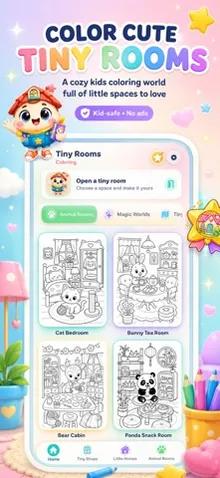
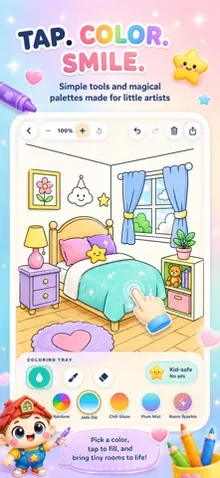
Each room in Tiny Rooms is illustrated with the same attention to furniture and layout you’d expect from a dollhouse-design app, not just a coloring app with a room-shaped outline. Rooms are broken into distinct zones — walls, rugs, furniture pieces, small props — which lets kids make deliberate color choices rather than just filling in one big shape.
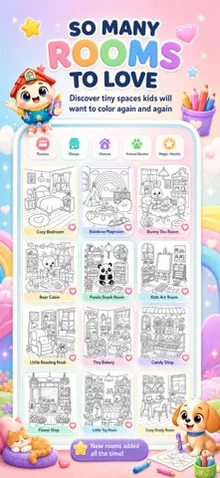
The content library spans everyday room types (bedroom, kitchen, playroom) with enough visual variety between them that the format doesn’t feel repetitive after the first few rooms.
User Experience
Tiny Rooms opens to a room gallery, and picking a room drops straight into the coloring/decorating canvas. Because rooms have more distinct zones than a typical coloring page, first-time use benefits from a parent walking through the first room together — after that, most kids pick up the pattern quickly.
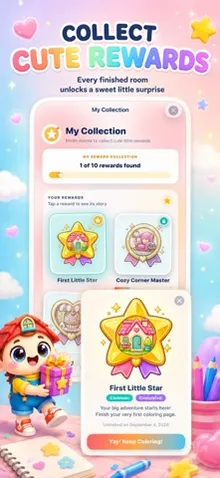
Undo and a clear “done” state for each room make it easy to know when a project is finished versus still in progress, which is genuinely useful given how open-ended the room format is.
Safety
The app is self-contained with no external links, chat, or user-generated content surfaced in testing. As with any app, we recommend confirming current in-app purchase and ad behavior directly on the App Store listing before installing for a child, since monetization can change between app updates.
Ads & Distractions
At the time of testing, the room-decorating canvas itself did not surface ads during a session. Treat this as accurate as of our last test date — we reverify on each testing pass rather than assuming behavior stays constant across updates.
Offline Functionality
Rooms loaded during testing were colorable without an active connection. If offline use for travel is a priority, we recommend loading the rooms you plan to use while still connected.
Pricing
We keep pricing details tied to the live App Store listing rather than restating a number here that could go stale — check the current listing for up-to-date pricing.
Age Suitability
The room-design format rewards a bit more patience and spatial thinking than a flat coloring page, which puts its sweet spot slightly older than typical toddler coloring apps — roughly ages 5–11 in our testing, with younger kids benefiting from a parent’s help on their first room.
Performance
Rooms with many small decorative elements loaded and rendered smoothly on the devices we tested, without noticeable slowdown while switching color swatches.
Alternatives
For a more traditional single-page coloring format with real animals, see our Capybara Coloring for Kids review. For a softer, fantasy-themed alternative, see Magic Unicorn: Kids Coloring.
Final Verdict
Tiny Rooms stands out from typical coloring apps by giving kids a small design project instead of a flat page — a strong pick for kids who already gravitate toward dollhouses or room-decorating play.
Related Reviews
Capybara Coloring for Kids Review
Our hands-on review of Capybara Coloring for Kids — a friendly animal-themed coloring app for kids on iPhone and iPad.
Magic Unicorn: Kids Coloring Review
Our hands-on review of Magic Unicorn: Kids Coloring — a kawaii-style unicorn and fantasy coloring app for kids on iPhone and iPad.